





The product's shade and actual color may differ from what is shown in the picture, as the images are for illustrative purposes. The product description is general and may not include all the product's features.
Rebel gra Black las 90569
4031773 90569
5906954790569
Shipping 8-13 b.d.
All about the product
The oldest known glassworks in the Black Forest, part of the forest glass workshops, dates back to 1218. Small forest settlements often formed around the glass workshops, inhabited by glassblowers and their families, as well as builders who supplied coal and potash needed for production. Extensive forests allowed operations to continue, as glass manufacturers could relocate their activities every few years. Then, families would convert abandoned glassworks into homes and outbuildings, while agriculture and livestock provided their livelihood. This resulted in the emergence of numerous agricultural estates throughout the Black Forest, many of which developed into towns and villages.
In the Black Forest, you start with a small estate – you will need new buildings and livestock. You will travel from village to village seeking the help of the best craftsmen. Choose the right buildings, add landscapes, produce glass, and expand your estate! Two resource wheels help manage goods and production, and the wide selection of buildings and their various effects opens many paths to victory.
What does it include?
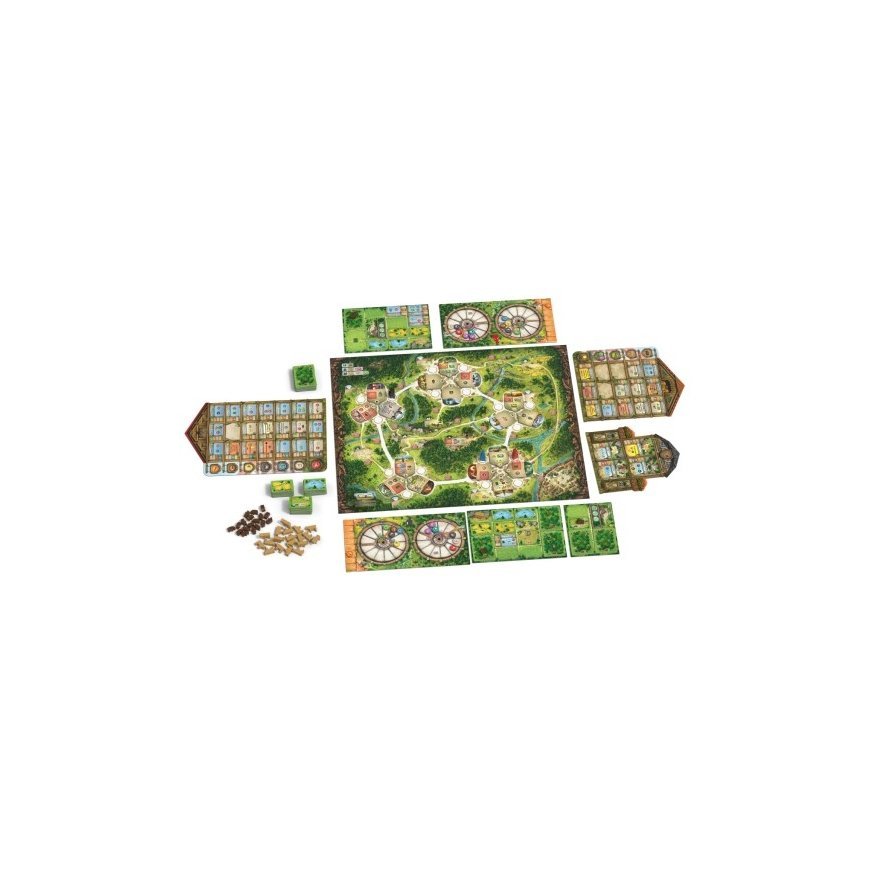
- Each player begins from their estate – an area they can expand and enrich with forests, fields, and ponds. Additionally, each player has their production board, which contains resource wheels for managing accumulated goods.
- The second important area is the main board, which has spaces where we can direct our infantry. Some of these spaces are adjacent to craftsmen's workshops – the tiles representing them will change their position throughout the game.
- During their turn, a player can use a special resource to swap the positions of two craftsmen on the board. Then, they move their infantry and perform an action assigned to at least one of the spaces they occupy.
- This way, we will accumulate resources and exchange them for others, while also managing the buildings and territories belonging to our estates.
- The game ends when at least one food marker on the player's cooking wheel reaches the corresponding space. After the final turn, points for collected resources, real estate, animals, and buildings are totaled to determine the winner.
Why will you enjoy this game?
- This game excellently enters the realm of complex strategy. Its rules are intuitive and quite simple (especially once you've mastered the resource wheels), and the game revolves around exchanging goods for others, and later for even more valuable ones.
- It's a true pleasure for fans of board games created by Uwe Rosenberg. You will find legendary resource wheels from “Ora et Labora” and “The Glass Trail,” this time combined with a worker placement mechanic in a dynamically changing board.
- With a plethora of possible elements (from various, dual-sided buildings to a range of accessible workshops and our own resource management), each game differs from the last and allows for completely new strategies to be explored.
- In addition to the classic game mode, the guide also describes a special two-player variant, enriched with an additional mechanism that increases interaction.