







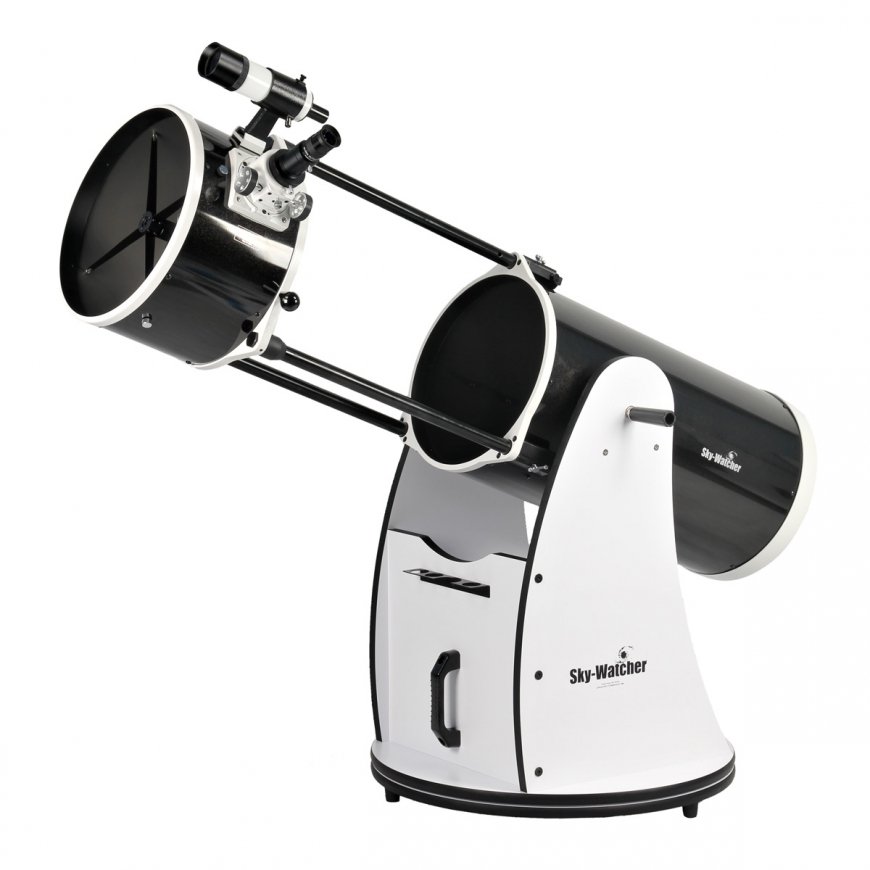
The product's shade and actual color may differ from what is shown in the picture, as the images are for illustrative purposes. The product description is general and may not include all the product's features.
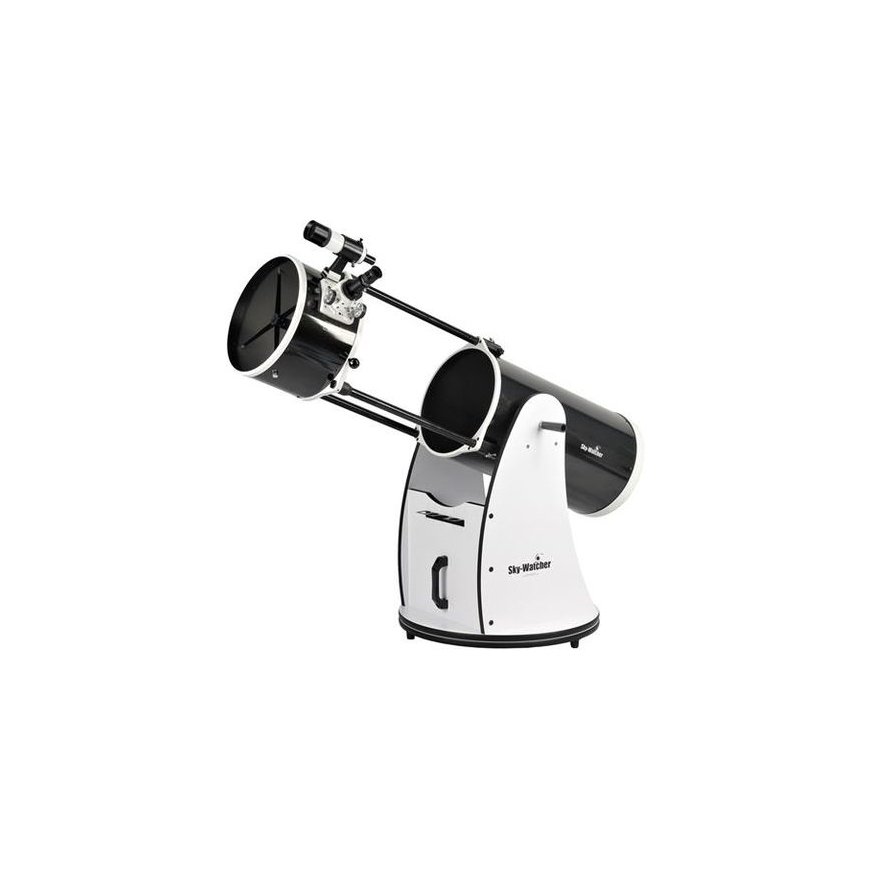
Skywatcher Dobsonian Telescope 12" Flex Tube 305/1500
3435312 SW-1312
5901691600829
2026-07-31
“Sky-Watcher” is a global leader in the production of telescopes, especially Newtonian telescopes with Dobsonian mounts. For many years, the company has focused on the highest quality of optics used in its telescopes, which is reflected in the most beautiful images of the Universe and numerous positive reviews worldwide. A large experience dating back to 1990 means that “Sky-Watcher” Dobsonians are produced in the most elegant, mature, and classic form, which is the most economical and accessible. Although there are many imitators on the market, none can match “Sky-Watcher”’s ability to create Dobsonian telescopes that are not only optically excellent but also affordable.
FROM FEBRUARY 1, 2017, WE WILL EXTEND THE “SKY-WATCHER” TELESCOPE WARRANTY TO 5 YEARS!
A 2-year warranty is provided for electronic and drive components.
A very large reflecting telescope designed for demanding (though not necessarily advanced) astronomy enthusiasts. This telescope allows for excellent observation of all types of celestial bodies and, given its size, is usually limited by the state of the Earth's atmosphere rather than its true optical capabilities. In particular, these telescopes are characterized by an excellent ability to gather light, which beautifully reveals distant nebulae, galaxies, and star clusters under a dark sky.
Optical system
The telescope is designed according to the Newtonian system. The parabolic primary mirror, made of Pyrex glass, has a diameter of 305 mm and a focal length of 1500 mm. It is coated with an aluminum layer and additionally protected by a quartz coating, which is resistant to oxidation and scratches. The large secondary mirror of the telescope is made similarly. This system, with a light intensity slightly greater than f/5, allows for very bright images at low magnification and large fields of view, making this telescope excellent for observing nebulae and galaxies.
Retractable design
The “Sky-Watcher” design is unique in the market – large Dobsonian telescopes can be folded for storage, taking up much less space. Assembly is done thanks to sliding tube elements, requiring no tools and no need to disassemble the tube into separate elements. The telescope is ready for observation in seconds. The precisely manufactured mechanism eliminates the need for collimation each time after unfolding.
Pyrex mirror
All “Sky-Watcher” 8-inch and larger Dobsonian telescopes come standard with a PYREX mirror – low thermal expansion glass, which means the image quality of such a mirror is better than that of regular glass mirrors. In the 12-inch model, the mirror is attached to a tested 9-point cell with sliding support points to prevent any distortion of the mirror.
Mounting
The telescope is mounted on an azimuth Dobsonian mount. The Dobsonian mount has a simple and very stable construction, allowing for easy rotation of the telescope around the azimuth and altitude axes. The telescope is attached on both sides in a fork-type mount, and the entire upper part of the mount rotates around the base. Due to the very low center of gravity and the construction made of quite rigid materials, the telescope hangs much more stably than when using equatorial mounts.
Extraction
The telescope is equipped with a 2-inch eyepiece focuser with a 1.25-inch reduction. It is a “Crayford” extractor, operating smoothly and without play. With 2-inch extensions and 1.25-inch extensions/reductions. Extensions should be used alternately, not connected into one set. The extension cord is compatible with automatic focusing devices produced by “Sky-Watcher.”
1. Solar system
objects on the Moon's surface smaller than 1 km;
Sunspots and their complex structure, clearly visible photosphere granulation;
all planets of the solar system;
phases of Mercury and Venus, details of Venus's atmosphere visible with a gray filter
visible structures on Mars's disk, seasonal variability of ice caps visible
several different zones of Jupiter's bands and Galilean moons, transits of moons and shadows across the planet's disk
structure of Saturn's rings with Cassini's division, atmospheric bands, and several smaller moons of the planet
- Uranus and Neptune visible as bright blue disks
movement of many asteroids against the star background
observations of many faint comets, visible structure of comets
2. Stars
There are about 6.5 million stars in the sky with a brightness of about 13–14 magnitudes
Double and multiple stars, separated by more than 0.5 arc seconds.
beautifully visible colors of many stars
3. Nebula objects
all Messier catalog objects, hundreds of NGC and IC objects
hundreds of globular clusters, often resolved into individual stars down to the center
thousands of open clusters with many visible structural differences
hundreds of nebulae, many with details, impressive details of bright nebulae
hundreds of galaxies with visible details, clear disk shapes and angular positions, visible spiral arms
- visible structure and architecture of many planetary nebulae, significant contrast enhancement using nebula filters
- such a diameter telescope works excellently with narrowband filters, e.g., OIII
- visible subtle details of supernova remnants
- Under ideally dark skies, colors can appear brightest in planetary nebulae
Due to the increase in the telescope mirror diameter to over 30 cm, objects are seen much clearer, and details are presented more distinctly than in telescopes with a diameter of 20 or 25 cm. For this reason, the image seen through such a large telescope becomes sensitive to the influence of artificial light, air pollution, and atmospheric stability (seeing), as well as the precision of optical collimation. Please note these limitations and consider them to obtain optimal sky images with telescopes of 20 cm and larger.
The focal length of the telescope is f/5. For this reason, it is very important to use good quality astronomical eyepieces.
Ground observations
A telescope with this type of optics is not suitable for terrestrial observations. To invert the image, use a so-called erecting lens, which allows us to flip the image into its natural (upright) state. Together with a mounting lens and a holder on which it is placed, it can be used as a simple device for observations in terrestrial space. Since the Dobsonian mount allows for easy control of the telescope along vertical and horizontal axes, is very rigid, and reduces all vibrations, it becomes possible to observe aircraft at cruising altitude.