


When the grid goes down, a standalone petrol or diesel generator powers the fridge, lights, router and heating circulation pump until electricity returns. 1-3 kW covers basic household needs. To run a pump, lighting and chargers with headroom, take 5 kW or more. A generator must only be used outdoors.
Key takeaways
- A compact 1100 W inverter is enough for a fridge, lights, router and chargers, but a more powerful model gives better headroom for starting current.
- A running fridge draws 150-300 W, and about three times more when the compressor starts.
- Count electric stoves and boilers separately: they take kilowatts and usually require a generator of 5 kW or more.
- A generator works only outdoors because the exhaust contains carbon monoxide. An electrician connects it to the house wiring through a changeover switch panel.
- A test run and fresh fuel before the first storm matter more than any model.
What generator power do you need for a home and a fridge?
A single fridge needs a generator of 1 kW or more. A house with heating and household appliances needs 5 kW or more. For a precise figure, add up everything that will run at the same time and add headroom for starting currents.
Approximate figures are in the table; exact values are on each appliance's rating plate:
| Appliance | Running, W | Note |
|---|---|---|
| Fridge | 150-300 | starting current about 3 times higher |
| Heating circulation pump | 100-200 | needed for the system to work |
| Lighting, router, chargers | small load | LED lamps barely load a generator |
| Electric stove, boiler | count separately | heavy load, need powerful generators |
For example, a fridge with a starting current up to 900 W, a 200 W pump and a couple of chargers fit a 1100 W inverter if you do not switch everything on at once. With an electric boiler, stove or a submersible well pump, look at 5-6.5 kW.
Which is better for a home: petrol, diesel or inverter generator?
An inverter petrol generator is quiet and protects sensitive electronics. A regular petrol unit works as an inexpensive backup for a few hours, while a diesel one can run for long periods under load. Choose by what you plan to power and how long the grid may stay down.
An inverter gives stable voltage and is safe for laptops, routers and boiler electronics. The Zipper ZI-STE1100IV delivers 1100 W, has a 4.2 L tank, weighs 12.8 kg and has a sound pressure level of 74 dB.
A regular petrol generator of the same output costs less to buy. The Daewoo GDA line with a 30 L tank is designed to power a whole house.
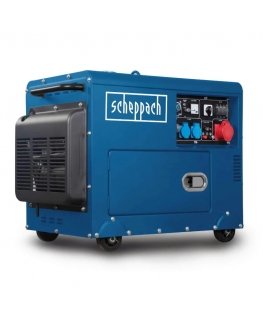
Diesel costs more and weighs more, but is built for long running. The Scheppach SG5200D is three-phase, 400 V / 230 V, with 5000 W maximum and 4200 W rated output, a 16 L tank and a weight of 148 kg.
Which generators in stock at cybermarket.ee suit power outages?
As of October 2026, the cybermarket.ee catalogue has models from 1100 W up to three-phase diesel units. Prices include Estonian VAT; availability is current at the time of writing.
| Model | Type and power | Price incl. VAT | In stock |
|---|---|---|---|
| Zipper ZI-STE1100IV | petrol inverter, 1100 W, 4.2 L tank | 266.90 € | 1 pc. |
| Daewoo GDA 6500 | petrol, 5000 W, 30 L tank | 556.26 € | 9 pcs. |
| Daewoo GDA 7500E-3 | petrol, 6000 W, 30 L tank | 549.54 € | 4 pcs. |
| Daewoo GDA 7500E | petrol, 6500 W, 30 L tank | 495.80 € | 5 pcs. |
| Könner & Söhnen KS 10000E 1/3 | petrol | 1108.19 € | 22 pcs. |
| Scheppach SG5200D | diesel, 5000 W, 400 V / 230 V, 16 L tank | 1320.46 € | 1 pc. |
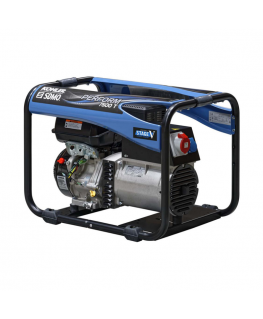
| Kohler SDMO Perform 7500 T C5 | Kohler SDMO generator | 1791.82 € | 5 pcs. |
The Zipper ZI-STE1100IV handles a fridge, lights and communications. If the house has a heating pump and household appliances, look at the Daewoo GDA 6500, GDA 7500E or GDA 7500E-3. The Scheppach SG5200D takes three-phase loads and long autonomous running. Detailed specifications for the Könner & Söhnen KS 10000E 1/3 and Kohler SDMO Perform 7500 T C5 are on their product pages.
How to connect a generator safely during a power outage?
Run a generator only outdoors, away from windows, doors and vents. It connects to the house wiring through a changeover switch panel installed by an electrician. Never plug a generator into a wall socket in reverse.
- The exhaust contains carbon monoxide: colourless, odourless and deadly. Garages, basements and enclosed verandas are not suitable. Put the generator under a canopy that protects from rain and snow but is open to air.
- Ground the generator as described in the manufacturer's manual for your model.
- The changeover switch between grid and generator stops current from flowing back into the line where linemen may be working. Leave its installation to an electrician.
- Backfeeding is forbidden: never plug the generator into a household socket.
- For powering appliances directly through an extension, use an outdoor cable of suitable cross-section and without damage.
How to store fuel for a generator and what to fill it with?
Keep fuel in dedicated sealed canisters outside living spaces and away from heat sources. Refuel only a cooled engine; never refuel a running or hot generator.
Buy canisters in advance rather than waiting for a storm: on outage day petrol stations may be overloaded. The fuel must match the model: petrol for petrol generators, diesel for diesel ones. Do not leave a full tank for long without a test run. Consumption depends on the model and load; exact figures are in the manual.
How to maintain a generator and do a test run?
Before storm season, check the oil level, spark plug, air filter, fuel and starting under load. If something is off, it is better to find out on a warm day than at night in a storm.
- Check the oil before every start. The Zipper ZI-STE1100IV takes 0.26 L, the Scheppach SG5200D 1.65 L.
- Once a month, run the engine for a few minutes with a load connected.
- Keep a spare spark plug and oil at hand.
- Dry storage protects the fuel system and electrics from corrosion.
What to prepare besides a generator for a power outage?
Besides a generator, you will want flashlights, power banks, a water supply, warm clothes and a plan for a long outage. A generator extends autonomy but does not replace preparation.
- Head and hand torches with spare batteries.
- Charged power banks for phones.
- Drinking water and food that needs no cooking.
- Warm blankets and clothes in case heating stops.
- A battery radio to follow the news.
- A fire extinguisher and a carbon monoxide detector near where the equipment runs.
How much power does a generator need for a fridge?
A running fridge uses 150-300 W, and 3 times more when the compressor starts. For a single fridge take a generator with headroom, at least 1000 W.
Can you run a generator in a garage or on a veranda?
No. Carbon monoxide from the exhaust builds up even with the doors open. Place the generator outdoors under a canopy, away from windows, doors and ventilation.
Can you connect a generator to the home grid yourself?
No. A generator is connected only through a grid/generator changeover panel installed by an electrician. A DIY setup through a socket is dangerous for you and for linemen working on the line.
How does a diesel generator differ from a petrol one?
A diesel unit is built for long running and three-phase loads, but costs more and weighs more. The Scheppach SG5200D weighs 148 kg and costs 1320.46 €, while the 5000 W petrol Daewoo GDA 6500 costs 556.26 €.
Related products
1113203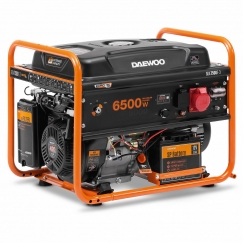
1120459597.90 €Monthly payment from 16,30 €MPN: GDA 7500E-36.5...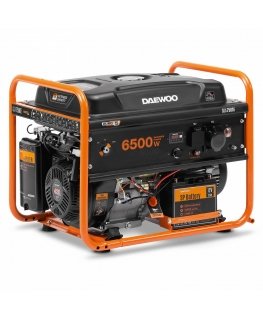
1123111551.49 €Monthly payment from 15,10 €MPN: GDA 7500E6.5...- -3%
14605191 217,77 € 36,26 € 1 181.51 €Monthly payment from 31,32 €MPN: 5906222903EAN: 4046664095583 
14697361 105.35 €Monthly payment from 29,36 €MPN: KS10000E1/3