
40,000 More Estonian Students Get AI Access in Classrooms This Fall
AI Leap ("TI hüpe") is Estonia's nationwide program bringing AI into schools: starting September 2026, it expands to 38,000 more students (vocational schools and new 10th-graders) and 2,000 teachers. Combined with the first 2025 wave, that's nearly 60,000 students and about 5,000 teachers nationwide - a significant share of all secondary and vocational education in Estonia.
Key points
- Since September 1, 2025, the program already covered 20,000 upper-secondary students and trained almost 4,900 teachers.
- From September 2026, 38,000 vocational and 10th-grade students join, plus 2,000 teachers.
- The AI app is built on ChatGPT, answers in Estonian, and gives guiding questions instead of ready homework answers.
- A dedicated NPU chip in a laptop isn't required for school AI tasks - all computing happens on OpenAI's servers.
- What matters more for studying: screen quality, RAM, and battery life for a full school day.
How did the first year go and why is the program expanding?
According to the TI-Hüpe foundation, by March 2026 the project involved about 20,000 students in grades 10-11 across all 154 gymnasiums in the country, and almost 4,900 teachers were trained - more than planned. 7,700 students activated an app account, and nearly half logged in weekly. This engagement became the basis for the second wave.
Who gets access this fall?
The second AI Leap wave covers 38,000 students: mostly vocational school students, joined by new 10th-graders. Along with them, 2,000 teachers will join and complete training before working with classes. Combined with the first wave, that's almost 60,000 students and about 5,000 teachers.
What AI tools are used in lessons?
The learning app is built on OpenAI's ChatGPT but configured differently from a regular chatbot: it gives guiding questions instead of ready homework answers. It responds in Estonian, except for foreign language lessons. Estonia's Ministry of Education is negotiating with Anthropic to add more partner models.
What hardware does this need at home and at school?
These AI apps run through a browser and connect to OpenAI and partner servers, so the student's device doesn't need to "think" for the AI itself. A powerful NPU isn't required for school AI tasks. What matters more is the screen for reading long texts, RAM so a dozen browser tabs don't lag during a video call, and battery life for a full day without an outlet.
Which Chromebook is best for basic AI tasks in a browser?
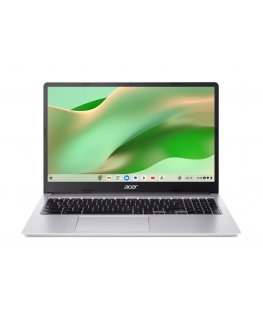
A Chromebook works if a browser with the learning app and online office documents is enough. The Acer Chromebook Tab 311 (11" FHD, 4/128GB) costs 349 € - with 4GB RAM it's better suited for younger grades. The Lenovo Chromebook Duet 11M889 (10.95" WUXGA, 8/128GB, 459 €) handles the AI app and multiple tabs more smoothly. The Lenovo Chromebook 14M8911 (14", MT Kompanio 540, 8/128GB, 529 €) offers a bigger screen for long study sessions.
| Model | Screen | Memory | Price |
|---|---|---|---|
| Acer Chromebook Tab 311 CW311-3HN-K7MY | 11" FHD | 4/128GB | 349 € |
| Lenovo Chromebook Duet 11M889 | 10.95" WUXGA | 8/128GB | 459 € |
| Lenovo Chromebook 14M8911 | 14" | 8/128GB | 529 € |
Which Windows laptop is needed for office software and exam prep?
If a full office suite or heavier tasks are needed beyond the AI app, the choice shifts to Windows. The HP Laptop 15-fc0043ny with Ryzen 3 5425U (15.6" FHD, 8/256GB, 409.72 €) is the cheapest way into Windows. The HP 15-fd0217nw with Core i3-N305 (15.6" FHD, 8/512GB, 499 €) doubles the storage. The HP 255 G10 with Ryzen 5 7530U (15.6" FHD, 16/512GB, 559 €) handles several heavy apps at once without lag thanks to 16GB RAM. The HP 255R G10 with Ryzen 5 7535U (15.6" FHD, 16GB DDR5/512GB, 627.69 €) adds faster memory, Radeon 660M graphics, and a three-year on-site warranty.
| Model | CPU | Memory | Price |
|---|---|---|---|
| HP Laptop 15-fc0043ny | Ryzen 3 5425U | 8/256GB | 409.72 € |
| HP 15-fd0217nw | Core i3-N305 | 8/512GB | 499 € |
| HP 255 G10 | Ryzen 5 7530U | 16/512GB | 559 € |
| HP 255R G10 | Ryzen 5 7535U | 16GB DDR5/512GB | 627.69 € |
Many families will this fall reassess whether their child's current laptop can handle the new learning mode. A dedicated AI chip isn't needed for school scenarios - all computing runs on OpenAI's and partners' servers. But RAM and screen quality are felt every day, and the laptop should last until evening without an outlet - that's what to focus on when buying a device for school.
How many students does the AI Leap program cover in fall 2026?
From September 2026, the first wave of 20,000 upper-secondary students is joined by another 38,000 vocational and 10th-grade students - almost 60,000 students across Estonia in total.
Does a laptop running the AI learning app need a dedicated NPU chip?
No, the school AI app runs through a browser and all computing happens on OpenAI's servers, so a powerful NPU in the laptop isn't required.
How much does a budget Chromebook for school cost in 2026?
The most affordable option is the Acer Chromebook Tab 311 CW311-3HN-K7MY at 349 €, with an 11" screen and 4/128GB of memory.
Which AI model powers the AI Leap learning app?
The app is built on OpenAI's ChatGPT and configured to give guiding questions instead of ready answers; Estonia's Ministry of Education is also in talks with Anthropic.